

New market study: Global Overview of the Thermoplastic Polyurethane (TPU) Market
IAL Consultants has published the fifth edition of its report entitled „Global Overview of the Thermoplastic Polyurethane Market“. The study examines the national, regional and global markets for thermoplastic polyurethanes for 2015 and builds up on the research from the previous editions. It explores the market trends driving TPU production and subsequent demand, provides an indication of raw material consumption, and also presents future growth opportunities in the TPU market. Five-year market forecasts to 2020 are also included.
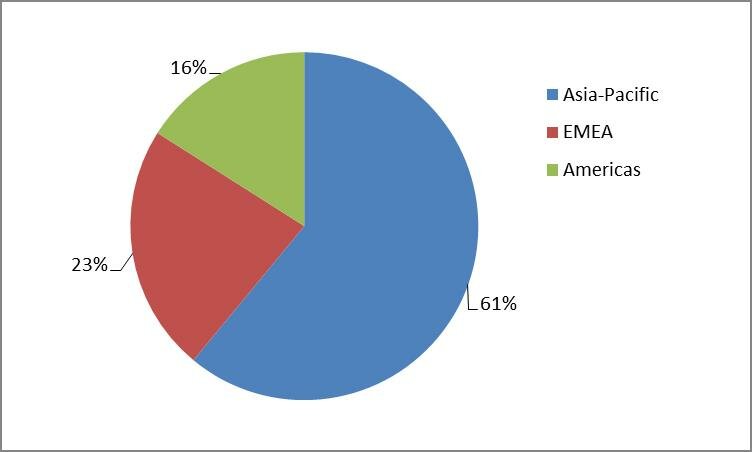
Fig. 1: Global TPU production by region, 2015 in % (Total = 496,000 t), Source: IAL Consultants6,000 t), Source: IAL Consultants
The total global market for thermoplastic polyurethane (TPU) was estimated at 496,000 t in 2015, with over 60 % of production taking place in APAC alone (fig. 1). The market is expected to grow by 3.7 % annually over the next five years, with most growth present in Asia.
According to IAL Consultants, the versatility of TPUs has allowed them to traditionally sustain one of the fastest growth rates within the polyurethane sector. Just like with many other industries, the outbreak of the economic downturn of 2008/2009 slowed down the consumption of TPU products, but this was followed by a period of prosperity in the TPU sector largely linked to the developments of the shale gas industry. However, the oil industry, which can generally be described in terms of its history of booms and busts, has entered a new downturn. Oil production is falling in the USA and other countries as exploration investments drop at a time when the world economic growth remains considerably slow.
On the contrary, this has not prevented an upsurge of interest from developing in the APAC region as a whole, leading China to continue strengthening its position as the largest TPU producer in Asia and the world, further enhanced by an array of capacity expansions in the country. At the same time, global TPU manufacturers are seeking to improve their supply chain links with China and the rest of Asia, with the European and American TPU markets being seen as more mature (less attractive).
Although the uptake of TPU has decelerated on a global level, including in Asia, the fastest growth rates are still focused in this geography. Indeed, the industry is convinced that Asia will continue to experience fast growth rates in the demand for the various TPU grades. Paradoxically, the slower growth rates are still higher than those encountered in other regions. However, TPU production in China is now forecast to grow by 4.7 % year-on-year to 2020 due to the sharp drop in the country’s GDP growth rates (currently standing at between 7 % and 8 % p.a.), from the previous double-digit rates attained in the past decades. The lower production growth rate is also a result of the difficulties encountered in the footwear sector, where China is reducing, if not losing, its competitive edge. Many footwear factories are shifting to the less expensive Southeast Asian countries of Malaysia, Vietnam or Indonesia, and many Chinese manufacturers have just opted to discontinue their operations altogether due to lower demand in export markets.
The global construction sector is also rather sluggish, thereby hampering the demand for TPUs in this sector, although there is a generalised upward trend in the usage of thermoformable composite panels based on glass-fibre-reinforced TPUs. A number of new, smaller applications are arising for TPUs within the automotive industry, as their use can result in lowering the vehicle’s weight, thereby contributing to decreasing fuel consumption and, in turn, CO2 emissions.
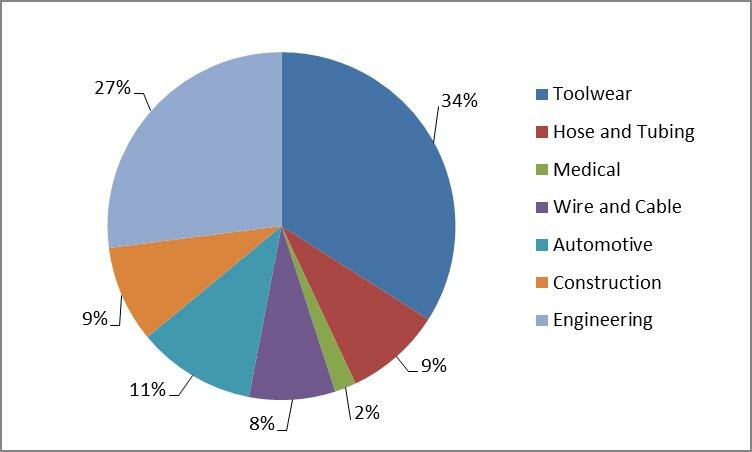
Fig. 2: Global TPU consumption by end-use, 2015 in % (Total = 479,000 t), Source: IAL Consultants
In wire, cable, hose and pipe applications, research continues to improve the service temperature and the overall performance of TPUs. Important improvements are being made in terms of flame retardant, halogen-free TPUs suitable for industrial and heavy-duty applications. A robust market is also developing for TPU hydraulic systems and in water pipeline systems (fig. 2).
Overall, the production levels of thermoplastic polyurethanes are being sustained thanks to the demand for lightweight materials in certain applications, and the high costs of manufacturing rubber (like PVCs) and metal parts, which intrinsically drive their substitution.
Now more than ever, both TPU producers and converters across all regions can expect innovation to play a key role in strengthening their relative positioning and gaining market share. Areas of interest are new technology platforms like 3D printing or expandable TPUs. Forecasts indicate that global production of TPU will increase by 3.7 % CAGR up until 2020. Higher rates will be seen in Asia (4.7 % CAGR); otherwise moderate growth rates are expected to be encountered in both the Americas (2.5 % CAGR) and EMEA (1.7 % CAGR).
The market report “Global Overview of the Thermoplastic Polyurethane Market” is now available from IAL Consultants, priced at EUR 3,800. Contact: Cathy Galbraith, e-mail cgalbraith@brggroup.com.

Like this article? Share Now!

More news from this section
Kraton: Global price increase for all HSBC products
Kraton announced on 5 January 2021 a general price increase of 220 USD/MT (USD 0.10 per pound) for all HSBC products. Subject to the terms of any applicable contracts, this price increase will take effect 15 January 2021.
read moreIRSG: PEFC International joins the IRSG Panel of Associates
The International Rubber Study Group (IRSG) announced that the Programme for the Endorsement of Forest Certification (PEFC), a global alliance of national forest certification systems, has joined the IRSG Panel of Associates.
read more
Write a comment on this article now