

From the “Nanoaugmented Materials Industry Summit 2017”
The third edition of OCSiAl's “Nanoaugmented Materials Industry Summit” took place from 15 – 16 November 2017 in Luxembourg. The event gathered together around 400 attendees from 30 countries to enjoy business networking opportunities while learning more about producing nanoaugmented materials with single wall carbon nanotubes.
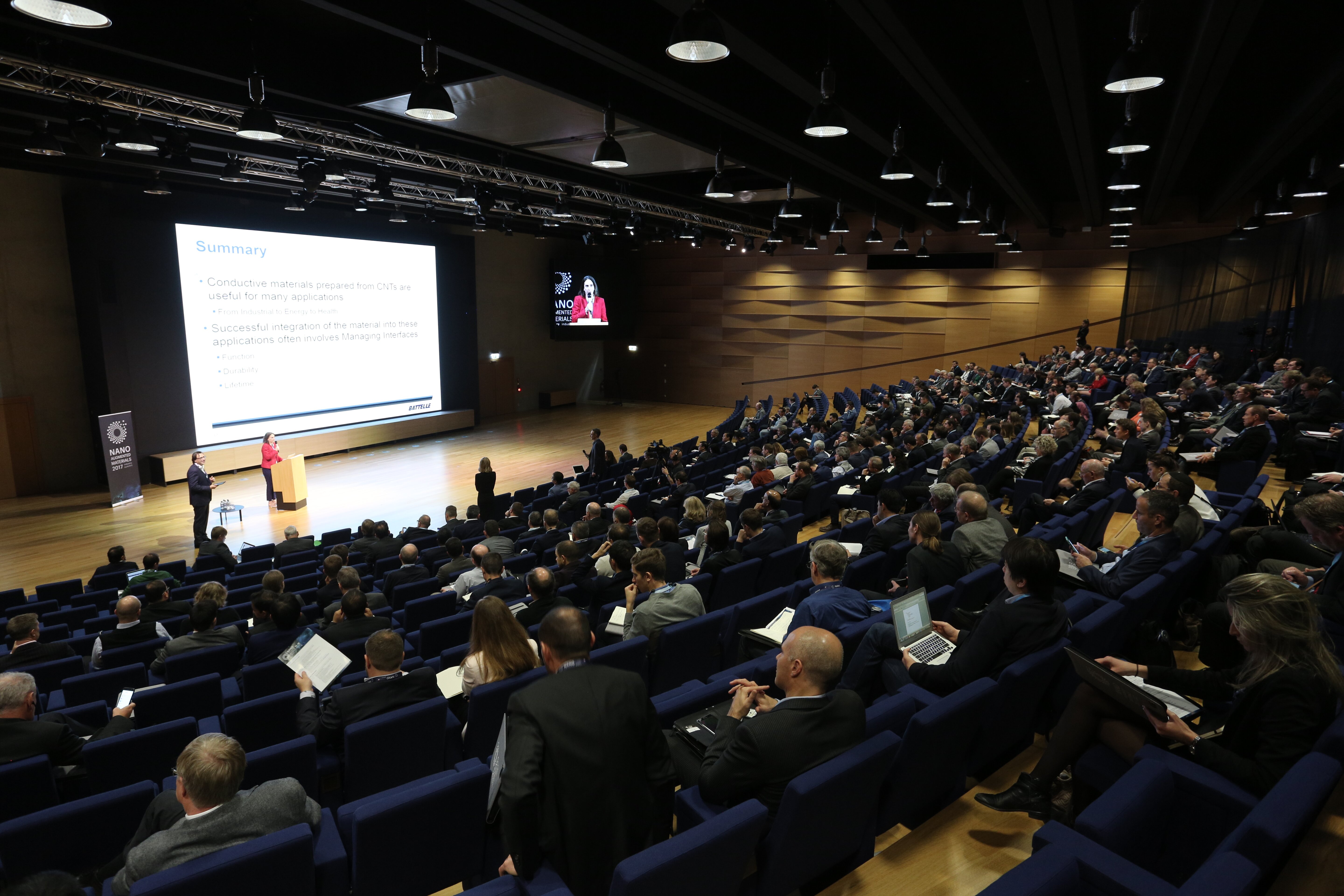
The “Nanoaugmented Materials Industry Summit 2017” gathered together around 400 attendees from 30 countries. (Source: OCSiAl)
According to the organiser, single wall carbon nanotubes are on the fast track to displacing carbon black, multi-wall carbon nanotubes, carbon fibres, and other conventional additives from their dominant position in the additives market. Pioneers in the field of advanced materials engineering gathered together at the summit to explore the advantages of this tiny wonder material and its applications in numerous industries, as well as to see how it is moving the boundaries of what is possible in the thermosets and thermoplastics industry in terms of weight reduction and performance improvement.
“Industrial applications of carbon nanotube compounds based on commodity polymers are now a reality,” commented Dimitri Rousseaux, Compounds & Composites R&D Manager at Total, during his presentation entitled “Opportunities and challenges of single wall carbon nanotubes in industrial applications”.
The world’s largest developed markets are always on the lookout for the most innovative technologies and they are highly motivated to gain competitive advantages by applying single wall carbon nanotubes, according to OCSiAl. “Tests conducted by one of our clients – a Chinese carbon fibre bicycle manufacturer – have demonstrated increased fracture toughness and interlaminar shear strength,” said Zhijun Liu, General Manager of Hongkong Haiyi Enterprise Development. The company has recently rolled out nanotube-based concentrates, providing the Chinese composites market with this nanotechnology.
Romesh Kaul, CEO – Stampings, Forgings & Composites Businesses, Mahindra CIE Automotive Limited, a global provider of automotive composites, discussed the solutions that the company has developed while working closely with OCSiAl over the last two years. “We have made breakthroughs in an electrical composites application with Tuball, which we will commercialise shortly. The tests we conducted on an application requiring impact strength revealed higher strength with Tuball.” With regard to these nanotube applications, Kaul added: “For the automotive segment, we see mechanical strength, impact strength, electrical semi-conducting, light weight and surface coating as the key applications.”
Büfa Composite Systems has developed and launched a line of commercial products containing Tuball nanotubes from OCSiAl, including gelcoats, GRP tooling, products made by a filament winding technique, SMC and BMC. Elmar Greiff, Project Leader for Nanocomposites, Büfa Composite Systems, said: “Another application is in conductive additives for composite tanks, where Tuball requires a lower dosage but provides better chemical resistance, lower viscosity, no reactivity drift and low contamination compared with the black powder of carbon black.” He added: “One big point for our customers is easier processing without requiring any special equipment.”
By successfully tackling a number of issues, single wall carbon nanotubes are finding their way in plastics. “We used Tuball at 0.2 % in ABS and PA plastic with our proven Fliquid system and achieved very good conductivity. Our newest development is Fliquid Powder system based on Polymer powder blend to allow easy dispersing in various systems,” said Daniel Florenthal, Joint CEO, Florma. The company has developed a number of nanotube-formulated compounds for thermoplastic applications, such as PP, ABS, HDPE, PA and PC.
Possessing a range of unique qualities, single wall carbon nanotubes enable the creation of new products with properties previously unattainable, said OCSiAl. Accordingly, they are being used in a growing number of end products. For instance, Prof. Hansang Kwon, CEO, Next-Generation Materials in Korea, said: “We’ve succeeded in overcoming the challenges faced by researchers in trying to create a so-called ’wonder material’ – a nanotube–aluminium composite.” Promising results in replacing LED and HID lighting with rechargeable laser lighting that incorporates nanotubes has led Prof. Kwon to conclude that “single wall carbon nanotubes are a strong candidate to change our society”.
Nanotubes could be highly relevant to nanofibres, allowing them to be used as a support material for various active materials while maintaining a high surface area, an open structure and a high aspect ratio. Jan Buk, Chief Operating Officer, Pardam, said: “There is a promising way to functionalise the nanofibres with single wall carbon nanotubes.” Moreover, the direct incorporation of active nanostructures is possible within one production step so there is no need for additional functionalisation, and nanostructures embedded in the nanofibre structure do not wash out during application. That is essential for developing electrically conductive polymeric nanofibres and catalytic inorganic nanofibres.
Acknowledging the fact that health and safety issues are a linchpin in any transformation of leading-edge technology into mainstream engineering and industry, OCSiAl said it continues its responsible approach to health, safety and environmental issues. At the summit, the company briefed its partners on the latest results received from independent laboratories, including confirmation that no nanotubes are released during utilisation of materials augmented with Tuball. “OCSiAl is planning to invest further in additional H&S and environmental studies because we are committed to taking the lead in raising the transparency of nanotube management and to supporting our clients’ efforts in boosting their applications in a wide range of industries, including consumable products,” added Gunther Van Kerckhove, OCSiAl’s EHS Lead Manager.
|
OCSiAl announced that it has chosen Shanghai, China, as the venue for the fourth edition of its “Nanoaugmented Materials Industry Summit” in 2018. |

Like this article? Share Now!


More news from this section
Covestro continues production at Tarragona site
Covestro announced that it will continue production in Tarragona, Spain, beyond 2020. The company will invest around EUR 200 million to increase the cost competitiveness at the site by implementing various measures. As a first step, it intends to build its own chlorine supply, thus ensuring an efficient, sustainable and independent supply of the crucial raw material. In addition, Covestro said it will also debottleneck its local MDI plant, increasing production capacity by 50,000 t/y to around 220,000 t/y.
read moreINDONESIA: Halcyon Agri acquires crumb rubber factory in Bintan
Natural rubber supplier Halcyon Agri is buying yet another crumb rubber factory in Indonesia, this time in Bintan.
read more
Write a comment on this article now