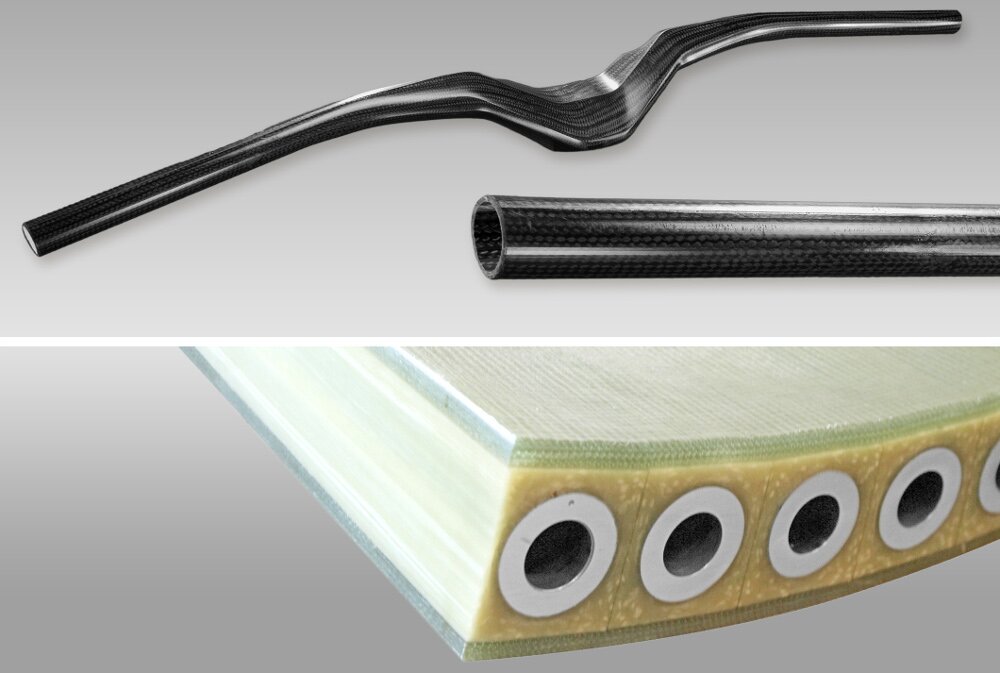
BASF will present, amongst others, a fibre-reinforced component made from Elastocoat C6226-100, which was developed together with Fiberline Composites. Furthermore, a mountain bike handlebar will be showcased as technology demonstrator for RTM hollow components.
BASF to present broad range of lightweight solutions at JEC World 2016
BASF Hall 6 Stand L39
At the JEC World 2016, which runs from 8 – 10 March 2016 in Paris, France, BASF will be presenting its solutions for composite applications made of polyurethanes, epoxy resins and thermoplastics.
For lightweight construction in automotive engineering, the company is showing various examples of current and future technologies with composite materials based on polyurethane systems and thermoplastics. The technology demonstrator for mountain bike handlebars illustrates how complex hollow components in automated high-volume series can be produced at competitive costs. Jointly developed by KTM Technologies, H2K Minerals, Teufelberger Composite, and BASF, it won the prize in the RTM category for this year’s JEC World Innovation Award. Known as “Cavus” the project gives an integrative view of the entire process chain. The demonstrator was produced in the HP RTM process with the PU reactive resin Elastolit R from BASF. According to the company, this compact reactive resin has a wide processing window at short demoulding times as well as good mechanical properties including good fatigue strength and high damage tolerance.
Thermoplastic composite materials with glass fibre or carbon fibre-reinforced tapes are a key element of Ultracom, the integrated system from BASF for continuous fibre-reinforced components in car body and chassis. In addition to semi-finished products and overmoulding compounds, the system also offers customers support from the concept phase via component design to simulation and processing including parts testing in order to enable efficient serial production. With thermoplastic unidirectional tapes component strengths can be adjusted in targeted ways to reduce weight even more while achieving higher quality and greater production efficiency, says BASF. This is illustrated by a number of demonstrators at the stand.
Already a serial part: the roof module with a honeycomb sandwich structure made in a single processing step with the polyurethane foam system Elastoflex E. The roof module in the standard model of the new smart fortwo consists of a paper honeycomb core and two glass fibre mats that have been impregnated in a spray process with low-density, thermally activated Elastoflex E 3532 and pressed with a solid-colour class A film.
Furthermore, BASF announced that it has expanded its portfolio of PU pultrusion systems. Pultruded parts manufactured from Elastocoat C have proved themselves in terms of fibre-matrix adhesion and dynamic properties. In addition, the pulling forces required in production have now been reduced in order to allow high pultrusion speeds. Furthermore, a system with low viscosity is now available for the production of carbon fibre pultruded parts with a high fibre content. Together with Fiberline Composites A/S in Denmark, BASF had already demonstrated the high performance level of PU pultrusion systems for components in the construction of rotor blades for wind turbines. Thick-walled profiles to integrate threaded bushings in the root section of the blade are made of Elastocoat C.
The Baxxodur epoxy resin systems and Kerdyn PET complete BASF’s range of solutions for the wind industry. They address the trend towards larger parts and comprise a variety of production processes. The Baxxodur system offerings for composites are based on the company's portfolio of amine-based curing agents. Kerdyn PET structural foam unites good mechanical properties with wide process compatibility. Thanks to its high temperature and chemical resistance, it adds stability to rotor blades, says BASF.
BASF will also present a new type of very strong and wind resistant utility poles made with its polyurethane system Elastolit. The technology was already proven in China and is now available in Europe as well. According to the company, these poles based on a filament winding technology are much lighter and at least 2.5 times more wind-resistant than the commonly used concrete utility poles for medium voltage grids. Due to their light weight – a 12 m composite pole weighs only 250 kg – they are easy to install and no heavy equipment is needed when erecting the poles. The bending strength of the new type is at least 2.5 times higher compared to concrete poles, which allows long distances between the single poles of up to 120 m.

Like this article? Share Now!

More news from this section

Amongst other highlights, the injection moulding machinery manufacturer Engel announced that it will demonstrate at the Chinaplas 2016 how LIM multi-component processes can be mastered reliably.
read more
The German machine manufacturer Arburg will be presenting its entire product range for the production of plastic parts – from one-off parts through to high-volume production – at the Chinaplas 2016.
read more
Write a comment on this article now