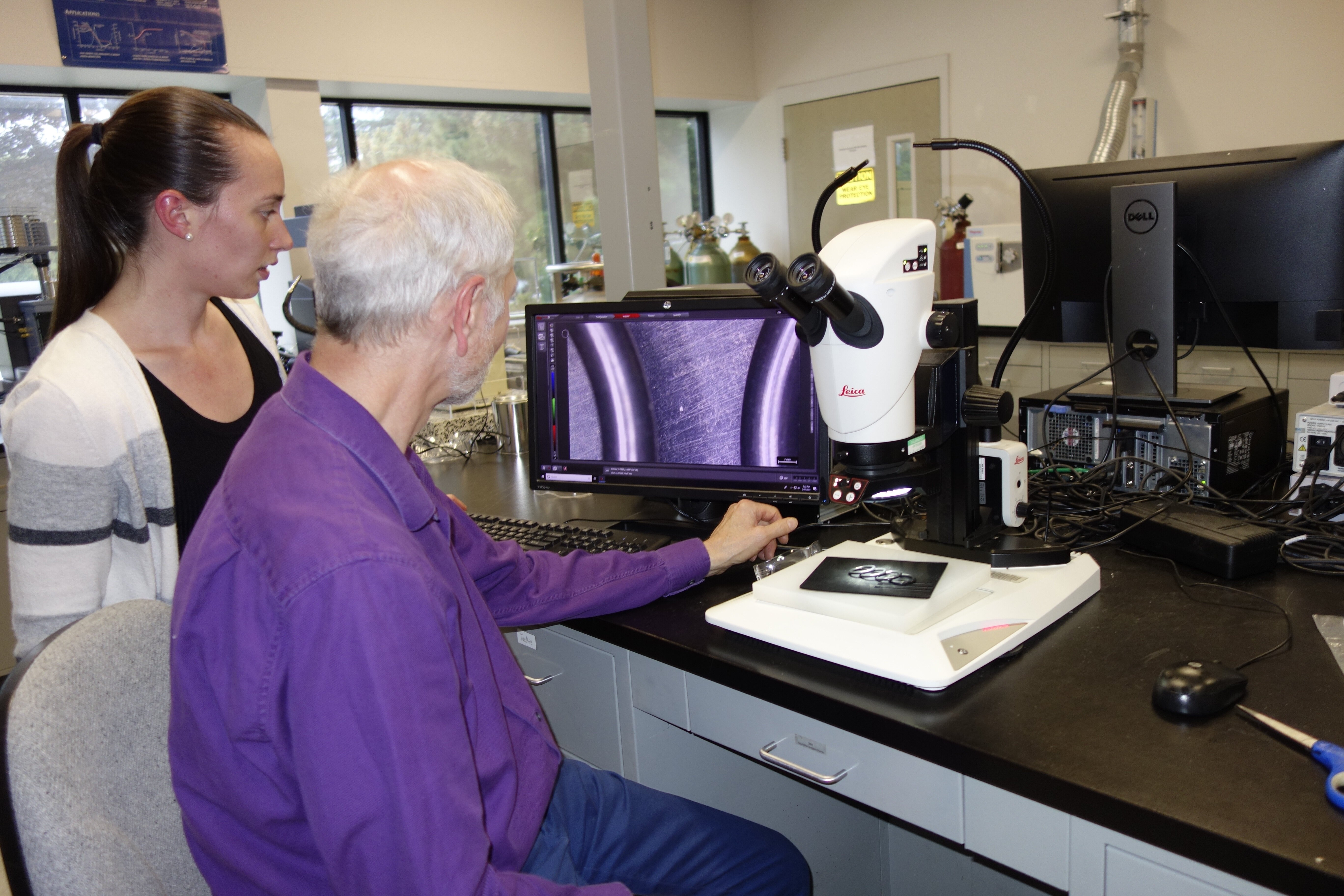
Chemist Jacqueline Schwark (links) und Dr. Paul Hochgesang, Material Research Fellow, examining the surface of EPDM seals. (Source: Freudenberg Sealing Technologies)
Freudenberg: New EPDM for the aerospace industry
Freudenberg Sealing Technologies has begun manufacturing seals made from a new Ethylene Propylene Diene Monomer (EPDM) material that addresses a significant challenge in the aerospace industry – hydraulic seal leakage at high altitudes and low temperatures.
The new material, 80 EPDM 426288, successfully seals hydraulic systems operating at temperatures as low as -85 °F (-65 °C). The material meets the rigorous requirements of the new AMS7361 specification for improved low temperature behavior in commercial aircraft hydraulic systems. In both lab testing and application, 80 EPDM 426288 demonstrates good low-temperature sealing behavior after extensive exposure to fluids, pressures and temperature extremes. EPDM can be crafted to resistant sunlight, ozone and chemical degradation, effectively seal phosphate-ester hydraulic fluids and other fluids and performs well at temperatures of up to 302 °F (150 °C).
Commercial airliners – which cruise at altitudes of up to 42,000 feet (12,801 m) and 575 mph (926 km/h) – rely on standard EPDM to seal critical hydraulic systems like those found in landing gear. At such altitudes and speeds, frictional heat – generated as the plane moves through the air – maintains hydraulic system temperatures within a range that preserves the performance integrity of traditional EPDM components.
Drones typically fly at 100 mph (160 km/h) or less at the same or even higher altitudes as commercial airliners. This reduces air friction and heat on the aircraft’s exterior. As a result, these aircraft must endure extended periods of very cold temperatures, followed by an abrupt change in temperature when they land. The same is also true of cargo carriers and other slow traveling aircraft. Standard EPDMs cannot tolerate prolonged exposure to very low temperatures without becoming brittle and cracking. The cracks can lead to fluid leaks in essential systems like hydraulic brake lines. At the same time, ongoing development of new hydraulic fluids prompts the evaluation of new material formulations.
Seals and components made from 80 EPDM 426288 have already been manufactured and tested in North America and Europe by several major aerospace manufacturers and system suppliers. Meanwhile production of aerospace O-rings made from this new EPDM has been launched.
www.fst.com
www.freudenberg.com

Like this article? Share Now!

More news from this section
Hasco: New engineering tool for mouldmaking

Because CAD computers in design are often not connected with the internet for security reasons, the internationally operating producer of standard mould units, Hasco, has come up with its newly developed offline software programme Hasco SET - Standard Engineering Tool geared specifically to the needs of mouldmaking designers.
read more
Continental, the University of Southern Denmark (SDU) and the École Normale Supérieure de Lyon in France have received a grant worth 43 million core hours of supercomputer time for their joint basic research project.
read more
Write a comment on this article now