

Covestro: Self-healing coating surfaces
DirectCoating (DC) with polyurethane coating systems is a new process for producing functionally highly integrated and nobly decorated plastic parts economically and sustainably. Rühl Puromer GmbH and Covestro have joined forces to expand the technology's suitability for large-scale production.
"We want to open up the process for broad use in electromobility and autonomous driving applications and use it, for example, to manufacture large-area decorative parts with multifunctional, seamlessly integrated display, operating and ambient lighting elements for car interiors," explained Dr. Olaf Zöllner, head of application development Europe in Covestro's Engineering Plastics business entity. "We also see good opportunities in highly integrated passenger car exterior parts such as spoilers, radar covers, front fascias and pillar trim with touch panels for vehicle access. There is also great potential in medical, communications and IT technology," added Dr. Ingo Kleba, managing director at Rühl Puromer.
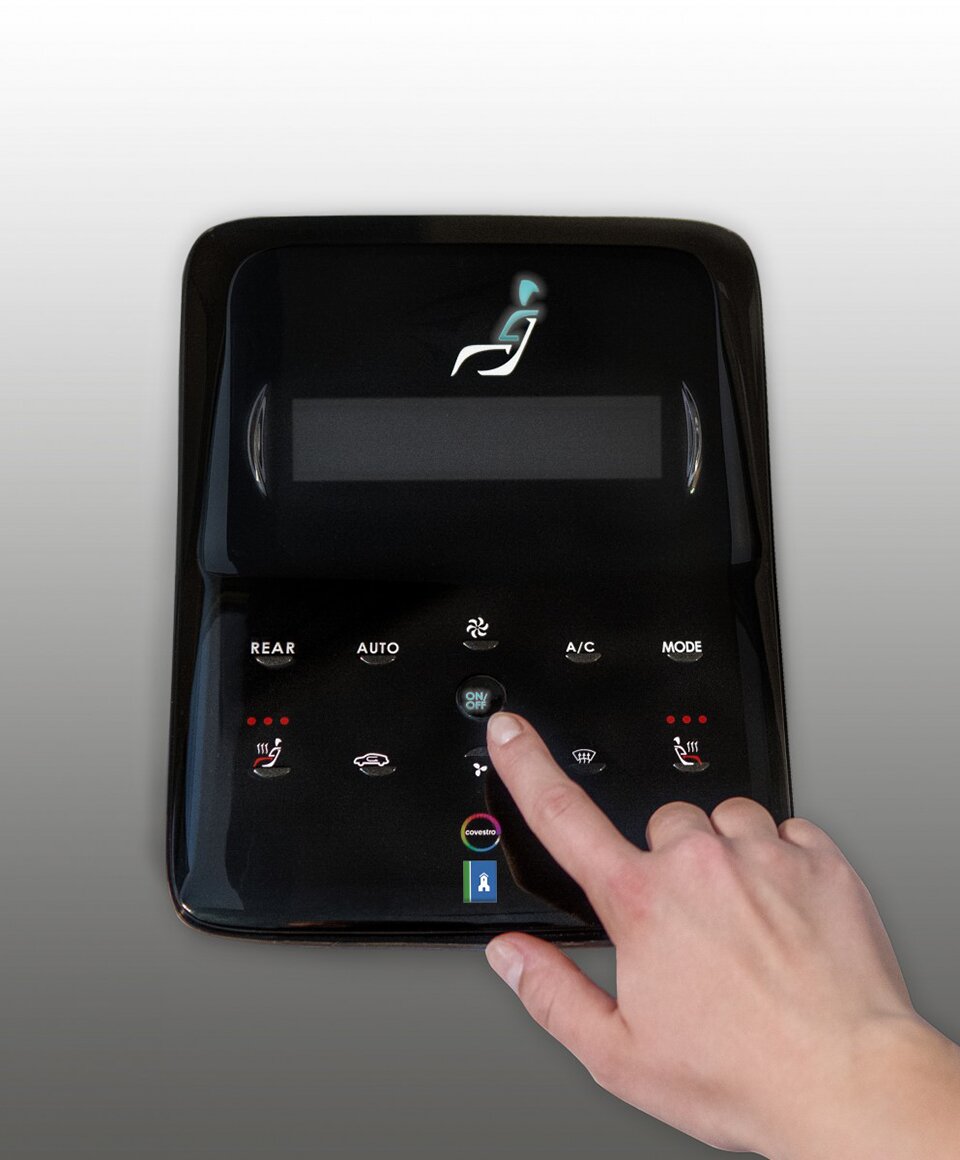 Demonstrator for the control panel of a centre console, produced using DirectCoating by back moulding a printed Makrofol polycarbonate film and surface finishing with deep gloss based on puroclear. (Source: Rühl Puromer))
The DC process combines two established technologies in one process: injection moulding of thermoplastics and reaction injection moulding (RIM) of PU systems. First, a thermoplastic carrier is produced in a mould cavity and then transferred to a second cavity, which is enlarged by the thickness of the coating layer. There, the PU system is then injected onto the carrier. The PU coatings offer unusually great freedom in design. The surface of the component can be made transparent, translucent or coloured through, and it can be made highly resistant to chemical media such as fatty skin creams or given leather-like soft-touch haptics. Filigree surface structures can be precisely moulded. High-gloss areas can be directly adjacent to matte structures. In addition, there is no need to invest in separate painting systems. Compared with spray painting, there is no paint loss due to overspray, and there is less scrap due to painting errors.
Covestro has built up special PC and PC blend compounds under the Makrolon, Bayblend and Makroblend brands for the DC process, as well as an extensive modular range of coating raw materials without solvent additives – such as special Desmodur isocyanate crosslinkers and Desmophen polyols – for PU coatings.
For the DC process, Rühl offers, among others, the light- and colour-stable 2K PU coating systems puroclear. Their RIM cycle times are usually at least equal to those of injection moulding. The systems contain an "internal release function" that has been proven in series production many times. The mould therefore does not have to be sprayed with release agent. This contributes to short cycle times and a simple process. In addition, self-healing variants have been added to the product range (reflow effect). Ingo Kleba said: "Superficial scratches in the paint, which are quickly caused by vehicle keys or stone chips, for example, disappear by themselves over time. The components retain their appearance, value and function for longer, which means maximum suitability for everyday use." Makrolon and transparent puroclear grades adhere firmly to each other in themselves. There was still room for improvement in terms of adhesion during ageing. The development partners therefore optimised several material combinations and assessed their adhesive strengths in the POSI peel test (ISO 4624). "We can now offer material systems that meet OEM adhesion specifications even after prolonged ageing in hot and humid environments," said Zöllner.
Precise simulation of the PU filling process and warpage are essential for optimal performance of a DC component. Covestro has developed suitable tools for this purpose. "With a new calculation method based on a two-phase CFD (computational fluid dynamics) simulation, it is now possible to precisely determine where air bubbles form during filling and whether they remain in the component or reach the mould vent. This was not possible with previous methods," explained Christoph Bontenackels, responsible for the calculation of DC components at Covestro. A new calculation tool is also available for simulating component distortion. It can be used to find the optimum layer thickness ratio for 3D structures with larger wall thickness jumps, at which warpage and cycle times are minimal.
The development partners want to expand the range of applications for the DC process even further. One approach is to integrate foils into the process in order to expand the possibilities for functional integration. For example, foils can be printed with conductive tracks and circuit diagrams on the reverse side, which is a prerequisite for equipping operating panels with backlit, inductive key functions.

Like this article? Share Now!

More news from this section
Hennecke: New ‘smart’ mixhead series
At this year's Fakuma, Hennecke, is putting the spotlight on its new smart MT-A mixhead series. Application experts for virtually every PU application area will present a total of three new mixhead series and a more optimized line-up in injector technology.
read moreLWB-Automation: Successful in-house-exhibition

From 16 – 24 August 2021, an in-house-exhibition took place at LWB-Automation in Weinheim, Germany, which was aimed at pre-invited company teams and was very well received. One of the reasons for this was the "anti-corona security concept" with pre-booked "time-slots", which limited the number of visitors present at the same time. The side effect of these measures, which was perceived as positive by both sides, was that it made it possible to provide interested parties with individual and more in-depth support.
read more
Write a comment on this article now