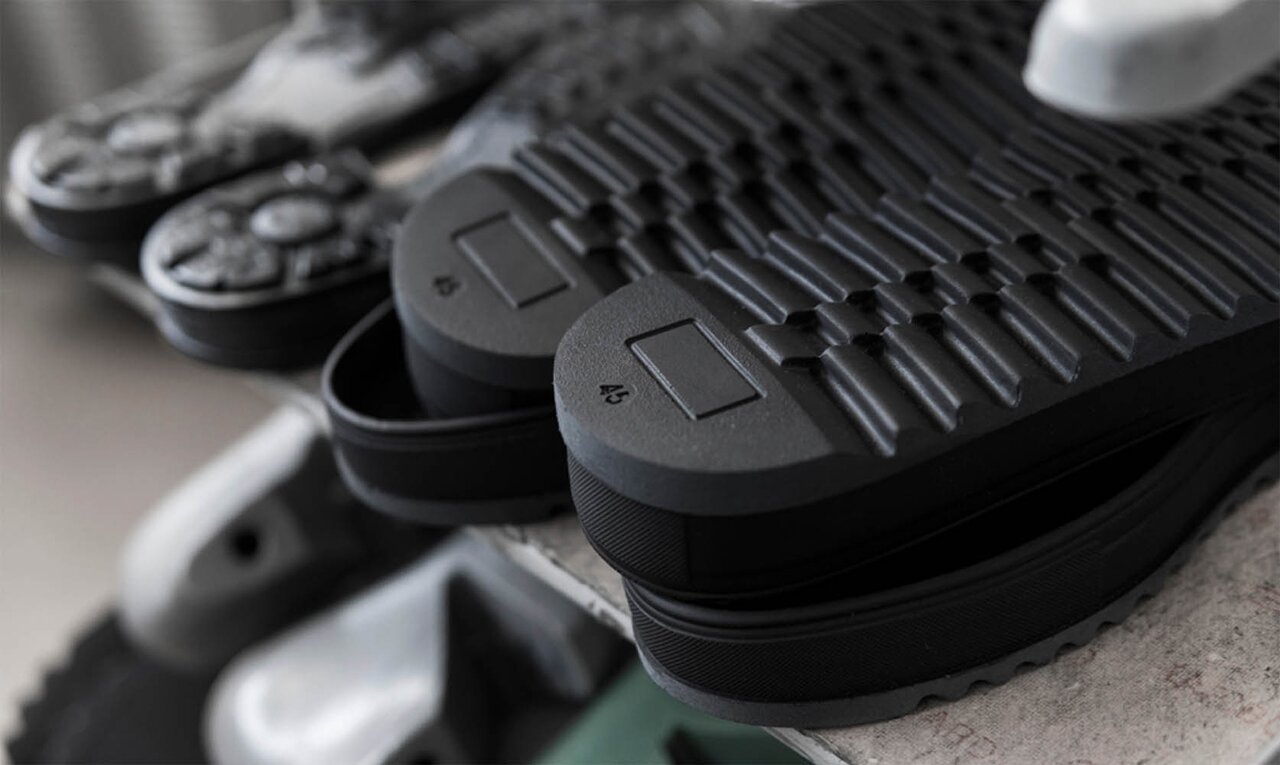
In the case of dual density soles, the release agents must provide a flawless finish, and above all a good bond of the soles is as an essential requirement. (Source: Concentrol)
Concentrol: Release agents for dual density footwear and soles
Concentrol offers release agents for manufacturers of shoe soles, safety footwear, military shoes and boots among others, and also for those who use direct injection processes. The extensive range is made up of solvent-based, hybrid, co-solvent and water-based products.
In addition, apart from having both ready-to-use and concentrates to dilute, the company offers tin-free and electrostatic-applied products. These are ready to be used in a convenient way, and with the guarantee of minimum dirtying of the mould, although for when necessary, Concentrol also has different options of specific cleaners.
Specifically, the company highlights these two lines of release agents for their performance and efficiency:
- LP ZBC-49 GVE, class II, solvent-based and with a satin finish, and
- LX ZBAC-01, water-based, to dilute and with a satin finish.
According to the company, among the many properties of the products, the following stand out: their high releasing power, the ability to perfectly and uniformly bond the midsole and the sole, their different flash points, their great adaptability to the parts defined in the design of footwear and the possibility of adjusting the surface finish depending on whether the customer prefers satin, matte or glossy. The use of these products provides great efficiency in the demoulding process and a substantial improvement in the productivity of the manufacturing chain, said Concentrol.
Dual density footwear is made up of two parts: an external polyurethane sole called an outsole and a midsole. The two parts are moulded and bonded to each other during the same production process. As its name indicates, the sole is made up of two layers of polyurethane of different density and colour, so that the densest and most compact is on the outside and the intermediate and less dense is located between the outer sole and the shoe. While the outer sole has good resistance to abrasion or oils, among others, the inner sole has the function of providing greater comfort to the user. With this combination, comfort and safety are united in a single sole. For the manufacture of the outer sole, the polyurethane is poured or injected into the mould, and then a false lid called a dummy is used to close it. At the end of the outsole cure cycle, the cap is lifted and the midsole foam is poured or injected. Then another lid is used to secure the mould and a second cure cycle is performed.
In direct injection processes, the upper part of the shoe, which is the textile part, is placed as a cover, and the polyurethane is injected under high pressure into the closed mould. In this way, the polyurethane foam cures and adheres permanently. This process eliminates the need for adhesives or seams, resulting in a significant improvement in time and productivity. In this case, problems in the injected polyurethane that involve rejection can lead to the loss of the entire shoe.
In the specific case of dual density soles, these release agents have to provide a good balance between release and bonding of the soles. First, the outsole is removed without touching it, the lid is lifted and another is placed to inject the second. This second one is injected onto the first, which has just been demoulded, so that any product residue that may remain on top of the first one does not hinder the gluing of the last one.

Like this article? Share Now!

More news from this section
Evonik / The Vita Group: Partnership for pioneering efficient PU mattress recycling process

Evonik announced that it has used its expertise in polyurethane chemistry to develop an efficient chemical recycling process for converting flexible PU foams back to the original polyol raw material. The company said its new hydrolysis recycling process has the potential to achieve circularity in the flexible PU foam industry.
read more
Grupo Antolin has presented its first headliner substrate produced by thermoforming a polyurethane foam with materials made from urban and post-consumer plastic waste and end of life tyres. The company said working with recycled materials is a natural step in its commitment to develop a sustainable business. The aim is to reduce waste and energy consumption during manufacturing and to meet the demand for eco-friendly interiors, something increasingly valued in car buyers' choices.
read more
Write a comment on this article now